Monday, November 18, 2013

Oxfam Helps Iowa Shine the Spotlight on Women

This week's post comes from Oxfam Action Corps San Francisco! Co-organizer Yoshiko Hill reports back on her experience at the World Food Prize & Borlaug Dialogue. 


Every year one of America's most quintessential agricultural states open its door to the most powerful players in food and agriculture to spark discussion around the future of food security and world hunger. Des Moines, Iowa welcomes elected officials, corporate executives, leaders in global development, renowned scientist and agriculture big wigs to the World Food Prize.

This year the three day conference featured keynotes from the President of Iceland, past UK Prime Minster Tony Blair and Cardinal Peter K.A. Turkson to name a few. The event certainly delivered on star power, but was lacking one important thing, the voices of the women and small-scale farmers who produce most of the world's food and represent 80% of the world's chronically hungry. This is where Oxfam America comes into play.

Oxfam has earned the largest non-profit presence at the World Food Prize and uses that position to secure prominent speaking roles for small-scale food producers from all over the world, including Oxfam's 2013 representatives, the awe-inspiring Kijoolu Kaliya and Harriet Nakabaale.
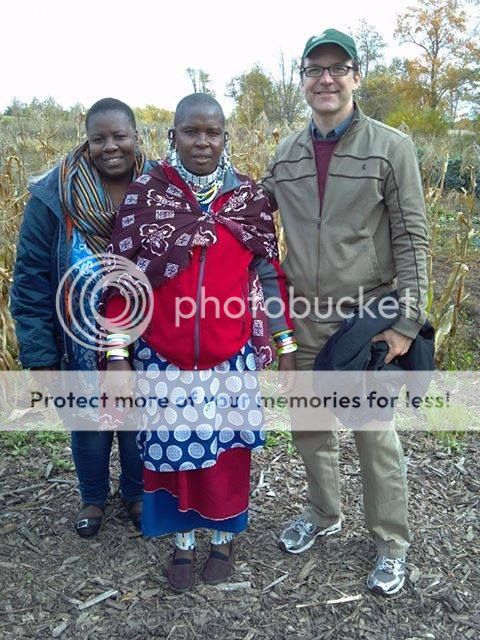
Kijoolu Kaliya featured center

On the largest stage at the conference, Kijoolu Kaliya shared her firsthand experience with land grabs to a packed room and some of the biggest applause received by any World Food Prize speaker. Ms. Kaliya is a member of the Masaai community in Tanzania and a prominent community leader as well as a pastoralist. Over the past four years, she has been forced to fight two land grabs threatening the livelihoods of her people. The most recent of which came from a rich investor from the United Arab Emirates who was attracted to the lush landscapes and thriving wildlife where Ms. Kaliya lives which the Masaai culture has been working to preserve and nurture for years. After the government of Tanzania approved the land deal with this investor , he decided that he would drive Ms. Kaliya and her community off of their land by force. The Masaai people had their homes burned to the ground and were physically assaulted by the investor's thugs. Masaai leaders are traditionally male, but after this egregious attack, Ms. Kaliya mobilized the women in her community to do what the men had failed to do, protect their way of live. She organized a five day trek to the capital of Tanzania to demand an audience with the President by returning 2,000 political party membership cards to the government. This show of force got the President's attention and resulted in him making a public declaration affirming that the Masaai people were the rightful owners of their own land and that the investor had no claim to it, but this declaration was only verbal and in this day and age a verbal agreement is little assurance, especially when it comes to the livelihood of your family. Now Ms. Kaliya is fighting for a written contract guaranteeing their land rights, because as Ms. Kaliya stated “land is life.”

Harriet Nakabaale featured center

Speaking at the Oxfam sponsored luncheon featuring Oxfam America's President Ray Offenheiser was  Harriet Nakabaale, a sustainable and organic farming advocate from Uganda's capital city Kampala. With help from her son Jjumba Frank Luyinda, Ms. Nakabaale turned her home into a small urban farm called Camp Green. Through Camp Green, the mother-son team teach local community members, schools and local governments the importance of finding creative ways to re-purpose what most people would consider waste, protect the environment, and grow sustainable and nourishing food. Together they work to alleviate poverty within and outside of Uganda by arming people with the knowledge necessary to take food security into their own hands and grow the food that they need. Ms. Nakabaale shared her story with hundreds of people and also stressed the importance of tackling domestic violence by empowering women with the necessary tools to become bread winners.

At this year's World Food Prize, on behalf of Oxfam America, Kijoolu Kaliya and Harriet Nakabaale gave voice to the underrepresented majority working towards food security on the ground - the small-scale farmers, community leaders and advocates. These two women helped bridge the gap between theoretical discussions and the harsh realities facing families and communities around the world while also shedding light on the meaningful triumphs women are helping to accomplish everyday.


Want to learn more? Check out this video from Harriet here! 
http://www.oxfamamerica.org/articles/harriet-nakabaales-camp-green/

Monday, November 4, 2013

World Food Day - and breaking the first rule of biology

Guest blogger Maria “Rose” Belding is a senior at Pella High School in Pella, Iowa. Maria is a social justice writer, advocate and one of the youngest selected candidates in the history of the Wallace-Carver Fellowship Program for scientific research. In this blog she writes about playing the ‘middleman’ in an Oxfam America Hunger Banquet, which is a special role invented by supporters in Iowa.  The middleman serves as gatekeeper to an extra helping of dinner, driving a hard bargain with participants.  This simulates the unfair terms by which many in poverty must negotiate access to needed markets, goods, and services.


I am an Oxfam America Hunger Banquet veteran. I have participated in events with 500 attendees and with 20, dinners held in formal ballrooms and in school cafeterias, and sat on the floor and stood at the podium. The dramatic contrasts between the rice on the carpet and the cheesecake on the table are no longer shocking to me, just sad; I am prepared for the opening speech, closing remarks and the radical shift in perspective that occurs in between.

This weekend, however, at what marked my tenth Hunger Banquet, I still found myself surprised.

As a returning alumni to the World Food Prize Foundation’s Global Youth Institute, I was volunteering as staff for the weekend and helped set up the Banquet. As we began to divvy up duties for the evening, I was asked to be the Middleman, essentially the only role I had not played in my multiple forays into the world of simulated wealth allocation.

I accepted the chance as a challenge: could I really be as mean as many middlemen had been to me?

Turns out, I could be and was. I was shocked by how easily I could manipulate participants into committing truly terrible acts, even though fictional ones. Asking the students and their teachers to behave as though they really were living the lives described on the colored cards that decided their fates, I was easily able to leverage what little assets or power they had. A woman who ran a shop in Afghanistan agreed to report back on the conversations of the American soldiers who stopped by her store in exchange for two meals. A recovering drug addict gave me access to his former circles and acted as a mule. Men sold me their sisters and sisters sold their sons. Actions we would all think unthinkable were considered or taken, even if it meant the loss of life.

I did as I was told I should; this was what was supposed to happen. The point was made, and the students and teachers learned.

Nobody warned me how bad I’d feel about it.

As I said earlier, the fact that hunger fuels desperation was not a new revelation for me. But being on the other side of the negotiating table showed me how easy it is to break all other rules when the first law of our biology has been transgressed - when we cannot give our bodies the fuel to function, all else is fair game if it will get us to what we need to survive. If we want to rid the world of its horrors, of genocides and human trafficking and drug trades, the best course of action will not be monitoring these atrocities and punishing the few offenders we can catch and convict. Instead, our greatest investment would be in feeding those who are not evil but may be forced to do evil things.

War is not always about weapons, and hunger is not always about food - but if we can prevent both by better allocating our resources, perhaps we can right the wrong after all.
 
The author (left), pictured at the Hunger Banquet in Des Moines with her business partner Tariro Makoni, fellow advocate. In addition to their work on engaging youth, the pair are also co-creators of the M.E.A.N.S Database, a system that allows food shelves to better communicate regarding surplus food.


Monday, October 28, 2013

Who Owns the World's Land?

Here's another great example of the amazing events Action Corps teams across the country put together in honor of World Food Day - this time, from Oxfam Action Corps Boston!

Originally posted at http://bostonoxfamactioncorps.blogspot.com

In honor of this year's World Food Day, the Action Corps in Boston hosted a film screening of Land Rush.  Land Rush was one of eight films in the Why Poverty?documentary series, which won a Peabody Award this year for Excellence in Journalism. Over 50 attendees gathered to learn more about global land grabs and their connection to sugar production. You might think hunger is about too many people and too little food, but this isn’t the case. Hunger is about power. Its roots lie in inequalities in access to resources, like fertile land and water. The power to control these resources doesn't sit with the billion-plus farmers who produce food.  Instead, companies and governments control the global food system—and they often determine who eats and who doesn’t.


Worldwide demand for sugar is set to rise by 25 percent by 2020. This growing demand for sugar will propel even greater competition for land. Three companies in particular—Coca-Cola, PepsiCo, and Associated British Foods (ABF)—buy and produce huge amounts of sugar around the world and hold significant influence over the industry. Right now, though, they are not doing enough to ensure that their suppliers and operations respect land rights.

At this event, the Action Corps was also honored to host the Land Rush's Producer, Eli Cane. Eli Cane is the Creative Director of Normal Life Pictures, a New York and London-based production company. 


Joining Eli was Irit Tamir, the Senior Advisor of Policy and Campaigns of Oxfam America's Private Sector Department.  Speaking about Oxfam's Behind the Brands Initiative and it's new direction, Irit explained the plan to hold corporations accountable for stopping land grabs. Take action now, sign the petition, and make your consumer voice heard! No company is too big to listen to it's buyers, not we all act as one.
Irit Tamir speaks to the audience regarding Oxfam's stance on small farmers rights

TAKE ACTION TODAY

Sign the petition HERE today, and share on your social media: 

On Twitter: Tell @CocaColaCo and @PepsiCo to take action against land grabs! Sign the petition at behindthebrands.org #BehindTheBrands

On Facebook: Stop land grabs! Tell Coca-Cola, PepsiCo, and ABF—some of the biggest buyers of sugar in the world—to make sure their sugar doesn’t lead to land grabs that force poor farmers and their families off their land. #BehindTheBrands


Interested in joining us? Like us on facebook, or email to find out how you can get involved in actions that create real change in global poverty.

**Photography credit: Sapana Thomas

Tuesday, October 22, 2013

World Food Day 2013


Oxfam Action Corps has been busy this World Food Day!  The Oxfam Action Corps held - and continue to hold - events around the country, e.g. packing the house for a 'Land Rush' screening in Boston, and featuring Jim Morris of the Indiana Pacers at the Indianapolis event.  Volunteers helped Oxfam stage stunts at key Coke and Pepsi locations in the US, while more than 100,000 people signed our petition via our ally "Sum of Us." And our Action Corps team expanded Oxfam's presence at the World Food Prize in Iowa, led by staffer Jim French, including tabling at a Hunger Banquet for nearly 300 people!


Kijoolu Kaliya (center), a member of the Maasai people of Tanzania has led a women’s mobilization to save their land from a foreign investor who wants to convert it to a private hunting reserve.  “Everybody in this world deserves a seat at the table,” she said.  Pictured here in Marshalltown, Iowa, with Oxfam staff members Mwanahamisi Salimu and Brian Rawson.  (photo: Brian Rawson)

Mwanahamisi Salimu of Tanzania shows John, a farmer in Marshalltown, Iowa, how sweet potato greens are prepared for eating.  John harvests some 200 pounds of sweet potato from the community farm at the Marshalltown Community College, saying that he intends to set aside what he’ll eat for the season and then “give the rest to the poor.”  (photo: Brian Rawson)

Oxfam America President Ray Offenheiser and Distinguished Professor of Sociology at Iowa State University Cornelia Flora are pictured in support of Oxfam’s petition urging major food companies to help stop land grabs, at the World Food Prize, Des Moines, Iowa.  (photo:  Brian Rawson)


In Albuquerque, NM, Sara and Jasmine of the Oxfam Action Corps dine at one of the area restaurants supporting World Food Day by distributing Oxfam placemats and campaign materials to customers. (photos: Kathy Chavez)

Celebrating WFD in Chicago with (left to right) Nancy Jones of Chicago Fair Trade Coalition, Adam Farag of Oxfam Action Corps, Adam Olson of Oxfam America, and Tom Leavitt chef at White Oak Gourmet and Oxfam Action Corps.
In Ames, Iowa, renowned author and activist Francis Moore Lappé joins Oxfam Action Corps members from Boston, San Francisco, Des Moines, and NYC.  (Left to right Suad Maow, Yoshiko Hill, Amy Luebbert, Francis Moore Lappe, Elizabeth Norman, and Brittany Wilson)
Taking the message to the Des Moines Farmers Market with Oxfam partners from Tanzania and Uganda, volunteers with the Oxfam Action Corps, and staff.  (photo: Sarah Kalloch)

At Gantry Plaza State Park, Long Island City
, Oxfam staff and volunteers mount a giant warning label.  (Photos: Vasia Markides)


In Atlanta, telling Coca-Cola to stop land grabs!

Thursday, October 17, 2013

No Sleep ‘til Des Moines? From Brooklyn to the World Food Prize

This week, dedicated members of the Oxfam Action Corps team are representing Oxfam America at the 2013 World Food Prize & Borlaug Dialogue. Read more from Elizabeth Norman, co-organizer of our team in NYC. 


----------------------------------------------------------------------------------------------------------------------------------

It’s 6:30 AM at La Guardia Airport; still dark outside. I am excited to be on the way to Des Moines to join other Oxfam volunteers and staff at the World Food Prize’s 2013 Borlaug Dialogue. Brittany Wilson and I are traveling from Brooklyn to Des Moines to represent the Oxfam Action Corps NYC as we join volunteers and staff from San Francisco, Boston, and of course, Iowa.

Oxfam’s presence at the World Food Prize will involve tabling and outreach, hosting three farmers visiting from Tanzania and Uganda, hosting a Grow Method luncheon, attending official events (highlights this year will include Tony Blair, former Prime Minister of Great Britain; Ólafur Ragnar Grímmson, President of Iceland; and Cardinal Peter K.A. Turkson, President of the Pontifical Council for Justice and Peace), as well as attending interesting side events. (Too many to choose from!) 

Camp Green in Kampala, Uganda
I am excited about hearing Frances Moore Lappé andOxfam America President Ray Offenheiser speak, meeting and hearing from farmers from Tanzania (Kijoolu Kaliya who has worked for land rights for Maasai women and men in Ngorongoro District) and Uganda (Harriet Nakabaale and Jjumba Frank Luyinda, urban farmers from Camp Green in Kampala) at Oxfam-sponsored events, tasting SRI rice at Oxfam's luncheonand visiting a farm connected with Marshalltown Community College on Friday.

Please stay tuned to this blog and watch for live updates on Facebook (https://www.facebook.com/OxfamActionCorpsNYC) and Twitter (www.twitter.com/OxfamActionNYC). 

Friday, October 4, 2013

Standing on Common Ground with Farmers Worldwide


 By Suad Maow, volunteer advocate, Oxfam Action Corps  boston@oxfamactioncorps.org
Photo: Suad Maow

As a volunteer advocate with Oxfam America’s Action Corps, I am very excited to participate in the Boston Local Food Festival.  I was born in Somalia and I wasn't exposed to any kind of food except for fresh food.  So, it came as a bit of a shock when I moved to Boston and had to eat food from a can or frozen breakfast items. 
But as I have gotten older, I am starting to see a shift in the way food is made available. There are more farmers markets and food festivals happening throughout the city and the country. This was not the case when I was a teenager. Seeing this shift is making me happy because I know the value of fresh food. I know that it’s better for the environment, cuts down on food waste, and is a healthier option. 
Do you ever wonder, like I often do, how to combine support for fresh, local foods with your impulse to do the right thing for farmers in developing countries like Somalia?  That’s where Oxfam can help you.  Many think that hunger is about too many people and too little food. But that’s not true. Our planet produces enough food to feed every woman, man, and child. Instead, hunger is about power. Its roots lie in inequalities in access to resources. Right now, many farmers in poor countries—the people who grow the food the world relies on—don’t have the power to access the resources they need to thrive.
We stand on common ground with these farmers.  Our voices and our food choices can help. Though we might be far apart, our problems aren’t so different. No matter where live, we all rely on the land—our common ground—and farmers to put food on the table. 
Come visit our table at the Boston Local Food Festival to learn actions you can take to help farmers worldwide, like these:
·         You can start right in your kitchen with Oxfam’s GROW Method.
·         You can help us stop land grabs. Governments and corporations are currently taking land that is not theirs, forcing families from their homes and leaving families hungry. You can speak up for farmers around the world and demand that companies develop land policies to protect their rights.
The main reason that I am excited to attend the Boston Local Food Festival is not only to taste delicious food, but just to hear the dialogue coming out of such a festival. The conversations that attendees will have pertaining to food are sure to be entertaining and educational. I can’t wait to eat delicious food and meet interesting people!
I’ll be looking forward to seeing you there!

Caption:  This placemat and other free materials are available at www.oxfamamerica.org/worldfoodday


Caption:  This placemat and other free materials are available at www.oxfamamerica.org/worldfoodday

Monday, September 30, 2013

Artistic Oxfam Appeal for Syrian Peace Talks


Action Corps NYC members participated in a media stunt outside of the UNGA, on behalf of Oxfam's call Syrian peace negotiations. Read on for more details from the event, as well as more information on Oxfam America's involvement in relief efforts for the Syrian refugee crisis.
Originally posted at http://www.oxfamactioncorpsnyc.org/2013/09/artistic-oxfam-appeal-for-syrian-peace.html
In New York City, the 68th United Nations General Assembly is currently underway. Global heads of states have gathered in an annual meeting which presents an opportunity for leaders from around the world to speak on behalf of their countries on the international world stage. With the United Nations as the host, there will be a particular focus on humanitarian aid and refugee relief efforts.
In Syria, an uprising against four decades of rule by the Assad family culminated into civil war that has lead to over 100,000 deaths and resulted in displacement for nearly one third of Syria’s population. The gathering of world leaders at the United Nations General Assembly provided Oxfam America with an opportune moment to undertake ongoing efforts in highlighting the crisis in Syria with the aim of stressing the urgency of Syrian peace talks.


Oxfam America appealed for Syrian Peace negotiations with the assistance of renowned Argentinian/Spanish 3D street artist, Eduardo Relero. Eduardo’s signature artwork enhanced by optical illusion has adorned streets around the globe. On this occasion, a large-scale painting portraying President Obama and President Putin in the midst of discussions was on display for several hours during the morning of Sept 25th at the Dag Hammarskjold Plaza.


The colossal painting is a particularly striking presentation depicting President Obama deep in thought while a map of various regions of Syria serves as a table as well as a barrier between the two Presidents in symbolic gesture. Both presidents are surrounded by fenced in refugees, composed primarily of women and children uprooted from their homes anxiously awaiting news of developments that will impact their lives.


Oxfam America staff, volunteers and media were available in full force on the scene in order to coordinate and speak to reporters about the event, provide support, and live tweet to amplify the message of the critical urgency for imminent peace negotiations in Syria.
Oxfam staff attendees included Oxfam America President, Raymond Offenheiser, Sue Rooks, working in Communications, Advocacy, Finance with Oxfam America, Media & Public Relations Director, Matt Herrick, Oxfam International Media Lead (Humanitarian), Louis Belanger as well as Oxfam America Regional Advocacy Lead, Will Fenton.


Volunteers who participated in making the day a success included NYC’s Oxfam Action Corps NYC’s current co-leader Elizabeth Norman, brand new NYC transplant and Oxfam volunteer from Grenada, Jennifer Viechweg as well as Sinead Kennedy who was instrumental in photographing and publicizing the event. Additionally, this event was an ideal opportunity for Oxfam staff from various offices and NYC Action Corps volunteers to be able to work in conjunction in person in joint effort to promote humanitarian relief.


The refugee crisis in Syria is unparallelled in recent times as the UN refugee agency, UNHCR figures state two million Syrians have fled from the escalating conflict, of which one million are children. Additionally, internal displacement figures are estimated to be at approximately 4.25 million. The Zaatari refugee camp in Jordan, within eight miles from the border of Syria is currently home to over 120,000 refugees and has been declared to be the second largest refugee camp in the world. With 2,000 new residents arriving each day at Zaatari, a second refugee camp, Azraq is undergoing construction, also with a capacity of 130,000.


However, only a small number of refugees are housed in the camps, the majority are scattered across various host nations. The countries in descending order of registered refugees are Lebanon, Jordan, Turkey, Iraq and Egypt. The influx has placed great strain on the recipient countries, several of which themselves suffer from instability and poor economies. A startling statistic that illustrates the scale and plight of the refugee crisis was recently released by Dana Sleiman, Public Information Officer for UNHCR in Beirut, Lebanon which stated that as school starts this week in Lebanon, it is expected that 330,000 Syrian refugee children will need to enroll in school in comparison with 300,000 Lebanese.

For ways you can help and to take action, please visit the following site: http://www.oxfamamerica.org/emergencies/syrian-conflict-and-refugee-crisis

By: Shireen Alam
Photography by: Fernando Olivas/Oxfam