Friday, January 10, 2014

Our Voices Have Been Heard: Coca-Cola Agrees to Zero Tolerance Policy for Land Grabs

Here is a great post from our Action Corps in the San Francisco Bay area, highlighting their work and success with the campaign!

Original post can be found at: http://sfbay-oxfamactioncorps.blogspot.com/


Our Voices Have Been Heard: 

Coca-Cola Agrees to Zero Tolerance Policy for Land Grabs


Ladies and Gentlemen, our hard work is paying off! All of our hours spent volunteering, campaigning, speaking out, and signing petitions is showing fruition. Over 225,000 people called for action to prevent land grabs and Coca-Cola has heard us. The food and beverage giant Coca-Cola has agreed to respect and protect the land rights of indigenous communities from which it sources its sugar. Specifically, Coca-Cola has agreed to:

  1. A zero tolerance policy on land grabs
  2. A “know and show” policy relating to being held accountable and aware of land rights and conflicts within its supply chain
  3. To support responsible agriculture investment and to advocate for governments and others to tackle land grabbing;
Sugar production requires a vast amount of land and is currently at an all time high triggering land conflicts and abuse. Coca-Cola is the largest sugar producer in the world making this news all the more amazing. Coca-Cola is the first beverage and food company to take such a stand, but should not be the last. For more information on this breaking news visit politicsofpoverty.oxfamamerica.org

Our mission and work does not end here. PepsiCo and Associated British Foods are some of the largest sugar producers in the world and as such we are urging them to follow in Coca-Cola’s footsteps and make a change in relation to the allowance of land grabs within their supply chains. In order to do this we need your help.
  

What Can You Do to Stop This?

Start by signing Oxfam's current petition to urge Pepsi-co and Associated British Foods to follow Coca-Cola’s example and hold themselves accountable for the land and human rights atrocities occurring in their supply chains. These huge companies have the market power to pressure their suppliers into committing to zero tolerance land grab policies and you have the power to pressure these food and beverage giants into stepping up and standing against land grabs. Make sure your voice is heard.

Then share the following messages:

Via Twitter

Tell @PepsiCo & #ABF to take action against land grabs! #BehindTheBrands

Via Facebook

Post the following message to PepsiCo's Facebook page

Stop land grabs! Tell PepsiCo and ABF—some of the biggest buyers of sugar in the world—to make sure their sugar doesn’t lead to land grabs that force poor farmers and their families off their land. #BehindTheBrands!

Thursday, January 2, 2014

Is there life after the Oxfam Action Corps?  Guest blogger Rebecca Light, a former organizer with the Oxfam Action Corps in Boston, writes about 'Inua," a new initiative in Tanzania (not affiliated with Oxfam).


I’m writing this blog post from the shores of the Indian Ocean, surrounded by coconut and banana trees, in 95 degree temperatures. It’s surreal for me to know that the holidays have quickly come and gone. It is a bizarre setting for a New England girl, who has never experienced a winter without snow! But here I am, in Bagamoyo, Tanzania, about to spend the next year working on a women’s education/socially conscious clothing project. Let me tell you how I got here.

I was a co-organizer for the Boston Oxfam Action Corps from 2012 to early 2013, and like many of you, participated in the training in Washington D.C. I listened intently to the speakers and engaged in discussions regarding extreme hunger and poverty, women’s issues, lack of educational opportunities and other social injustices around the world. I was excited to learn how we can bring about changes to help alleviate these issues. I enjoyed co-leading the monthly meetings and organizing events in Boston to raise awareness and inform policymakers of needed changes. I learned much about the experiences of people in developing countries and the ways in which Oxfam America is involved with on-the-ground initiatives. Learning how Oxfam supports the endeavors of local people to improve their communities and advocate for larger policy changes especially resonated with me. This, along with my profession as a social worker supporting marginalized women who are homeless in the Boston area, continued to solidify my passion for social justice and international development.

When the opportunity presented itself in the spring of 2013 to volunteer in Tanzania, I jumped on an airplane. What began as a three-month endeavor became a seven-month stay followed by the decision to move to Tanzania for another year to begin a development project. During my time in Tanzania, I have witnessed first hand many of the injustices and oppressive systems and policies we spent time discussing and working to change through the Action Corps. I am inspired to work within this community to empower women to enact needed change. I began working with another American woman, Sylvie Ofstie, who has a background in fashion, design and education and a local Tanzanian woman, Pili Mtonga, an accomplished tailor, designer, artist and educator. Together, we developed a women’s empowerment project called Inua, which means “lift up” in Swahili.

Inua’s goal is to lift up the community of Bagamoyo, Tanzania. As you know, it’s been demonstrated that if women are given tools and education, the impact is widespread and long lasting. Inua’s vision is to empower young women by teaching them the skills of tailoring, design, and other crafts, which can be used to generate income. The program also offers English and computer courses, which can open doors for further job and education opportunities. Pili and I developed a curriculum for a year-long workshop for young women who are unable to complete their education due to lack of income and other factors. Without access to education, young women often do not obtain job skills or a way to earn a sustainable income and often end up married and pregnant at a young age, thus continuing the cycle of extreme poverty. The workshop began in September and the first group of students will attend through August 2014.


In order to create a self-sustaining model, in collaboration with Pili and her tailors we have created a socially conscious clothing line called naSuma. Pili and Sylvie design unique, beautiful clothing and other items made from traditional, vibrant African fabrics. Not only does this provide a fair, sustainable source of income for the tailors, but it will also be the source of funding for Inua. We sell these items on our Designs From Bagamoyo FB page, our Etsy Shop, in Pili’s shop in Bagamoyo, and we have connected with several boutiques in the US and Europe to sell the Spring/Summer 2014 collection.

To reach our goal of complete sustainability, we’ve created a fundraising campaign on Indiegogo. The funds we generate via the campaign will allow us to expand naSuma and operate and develop Inua in the upcoming year. We have just 13 days left to reach our goal of $15,000.

I know that within the community of Oxfam Action Corps, we all share a passion for social justice and opportunity for individuals to use skills and resources to self-empower. Please join us by contributing to the fundraising campaign (and get some great perks for doing it)! Please also share the link with your networks. We need as wide a reach as possible, so together we can make the greatest impact; one that is both self-sustaining and empowering for women and the community in Bagamoyo.

Peace and joy,
~Rebecca

Click the link below for our indiegogo campaign page:


Monday, December 16, 2013

Typhoon Haiyan: Relief and Rehabilitation

This week, we are sharing a post from Oxfam Action Corps NYC volunteer Nikko Viquiera. Read on for his personal take on the devastation caused by Typhoon Haiyan and the steps towards recovery.


When news of a super typhoon about to hit central Philippines started coming out last month, many Filipinos, including me, shrugged it off and went on with our regular schedule, knowing that country gets an average of 22 typhoons annually. A day after the typhoon came; news outlets reported less than a hundred dead people. People thought it could have been worse and were glad that it wasn’t as big of a tragedy as other major typhoons have been in the past.

Days later, nothing could have prepared us for the breadth and depth of the devastation caused by typhoon Haiyan. To date, over 5,000 people and counting are dead and 10 million other Filipinos have been affected in one way or another.

As a former Program Officer for Jesuit Volunteers Philippines (JVP), I used to visit volunteers in Samar, one of the hardest hit regions by the typhoon. JVP sends volunteers to marginalized communities around the country to serve as educators, youth formators and community organizers. One such community is Lawaan in Eastern Samar. It was a small, quiet town by the sea, where many fish and farmed for a living. I would visit the parish school where volunteers where assigned as educators for high school students. The community would always be very welcoming, serving me the best food and accommodation they had to offer when they did not have much.

One afternoon, I remember some of the students in the Parish school invited me to ring the 6:00 pm bell. We climbed the bell tower beside the Church, just as the sun was beginning to set. As I rang the bells that echoed through the town, the sun began to set on the people going home after a day’s work, on the children playing in the streets and the coconut trees that stood as tall as the bell tower.

Today, most of the town has been destroyed by Typhoon Haiyan. The once mighty coconut trees have fallen, along with many houses, the school and the church. A more recent picture shows that only the bell tower remains standing amidst a sea of debris and destruction.

And so it is for many other towns ravaged by the typhoon in Eastern Samar, Palawan and Cebu. Dead bodies are everywhere, waiting for surviving relatives to recognize and claim them. Just this week, 120 bodies were discovered under the San Juanico Bridge, the longest one in the country. Reports describe residents walking around aimlessly like zombies. They are dazed and confused, with no work to do and no house to go home to. As such, many have flown to cities such as Manila in search of jobs, anything to get away from the rubble of their previous lives, only to find themselves homeless and jobless in a city that can be as unkind and apathetic as a typhoon.

Yet in the darkness of the devastation shines the generosity of people. More developed countries such as the US, Japan, Australia and the United Kingdom have pledged millions of dollars in relief. Relief agencies such as Oxfam, Red Cross and Catholic Relief Services were quick to respond and have been present in the region since Day 1.Oxfam Pilipinas, in particular, through the generous donations of people all over the world, has been working to provide clean water and sanitation to victims of the typhoon. Individuals and small groups have organized themselves and made efforts to raise funds for the victims of the typhoon. In Manila, people have offered to take turns feeding and keeping those, who left their homes in search of livelihood, stranded in the airports company.

But as news of the typhoon and its deadly effects begin to fade in the news, the more difficult task of rebuilding and rehabilitation is just starting. How does one rebuild thousands of houses, roads and structures from the ground up, all at the same time? How do we bring back livelihood to towns where even trees no longer stand? How do we begin to bring back hope to those who are still counting their dead and their losses? How do we begin anew?

A month has passed since the typhoon killed thousands of people and left survivors hungry, homeless and jobless. And yet many groups and individuals continue to work in the Haiyan areas, this time with a focus on rehabilitation. Oxfam, for example, has distributed rice seeds to rural areas to help farmers earn income again.

Many have pointed to the resilience of the Filipino people to withstand any tragedy as the main key to rehabilitation. But as Christmas nears, and the tenuous task of rehabilitation unfolds before us, we realize that resilience is not enough. We also need critical minds, calm spirits and skilled, tireless hands that move together like waves in strength and unison.

Thursday, December 5, 2013

Action Corps keeps the pressure on Pepsi during Week of Action!

Since Coca-Cola committed to make sure the sugar in its products doesn’t lead to land grabs, it’s time for PepsiCo to follow Coca-Cola’s lead!
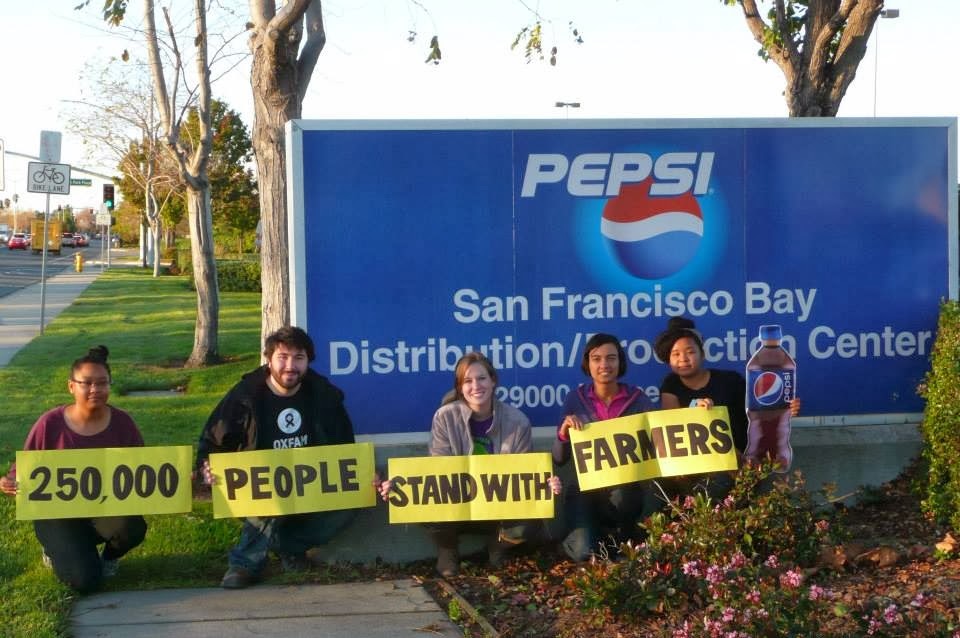
In an effort to drive PepsiCo's commitment, during the week of November 18th Oxfam's supporters across the U.S. drove to Pepsi bottling plants and corporate offices to deliver petitions, take stunt photos and tell Pepsi staff that over 250,000 people stand with farmers.


Oxfam Action Corps San Francisco
Our San Francisco volunteers outside of a Pepsi site

Action Corps Albuquerque, right before delivering some petition signatures!

Action Corps volunteers in Kansas City, MO

Action Corps & CHANGE made deliveries in over 20 states! See more pictures and see if your state is represented in the full  report of the deliveries here!

Monday, December 2, 2013

Don't Forget to Love Your Leftovers After Thanksgiving (and always...)

We wanted to share this timely post by Oxfam Action Corps New Mexico. Enjoy!  
By Kathy Chavez


The days are getting colder and the nights are longer, and many of us are getting ready to celebrate with friends and family. My favorite part of the holidays every year is eating and sharing my leftovers.


Growing up we cherished our food and would never throw any of it away. My mother taught us that wasting food was wrong with so many people in the world going hungry. My mother was right--food is too precious to waste. According to the Environmental Protection Agency one is six Americans lacks a secure food supply and suffers from hunger. And as much as 40% of food in the U.S. goes uneaten. According to estimates we are throwing out $165 billion in wasted food every year. Just 15% of this wasted food would be enough to feed more than 25 million Americans every year.


If that's not reason enough to save food, think of all the great dishes you can make with leftovers. My favorite is the simple sandwich. Take some meat and place it between two slices of bread or biscuits. You can always add chile, stuffing, mashed potatoes or cranberry sauce. If you don’t eat meat you can make it with tofu or hummus. Other favorites are soup, tacos, and Shepherd's pie. One very easy dish that comes to mind is mashed potato pile up. Take mashed potatoes (either sweet or white) and put them in a bowl, add vegetables, meat, beans, gravy or chile and gently mix them. Voila!


We wish you a safe and happy winter season full of leftovers. My best advice is to always wash your hands before handling food and do your best not to waste anything. If you can't eat it all, send food home with friends, or invite them over for leftovers.

Happy Holidays everyone!

Monday, November 18, 2013

Oxfam Helps Iowa Shine the Spotlight on Women

This week's post comes from Oxfam Action Corps San Francisco! Co-organizer Yoshiko Hill reports back on her experience at the World Food Prize & Borlaug Dialogue. 


Every year one of America's most quintessential agricultural states open its door to the most powerful players in food and agriculture to spark discussion around the future of food security and world hunger. Des Moines, Iowa welcomes elected officials, corporate executives, leaders in global development, renowned scientist and agriculture big wigs to the World Food Prize.

This year the three day conference featured keynotes from the President of Iceland, past UK Prime Minster Tony Blair and Cardinal Peter K.A. Turkson to name a few. The event certainly delivered on star power, but was lacking one important thing, the voices of the women and small-scale farmers who produce most of the world's food and represent 80% of the world's chronically hungry. This is where Oxfam America comes into play.

Oxfam has earned the largest non-profit presence at the World Food Prize and uses that position to secure prominent speaking roles for small-scale food producers from all over the world, including Oxfam's 2013 representatives, the awe-inspiring Kijoolu Kaliya and Harriet Nakabaale.

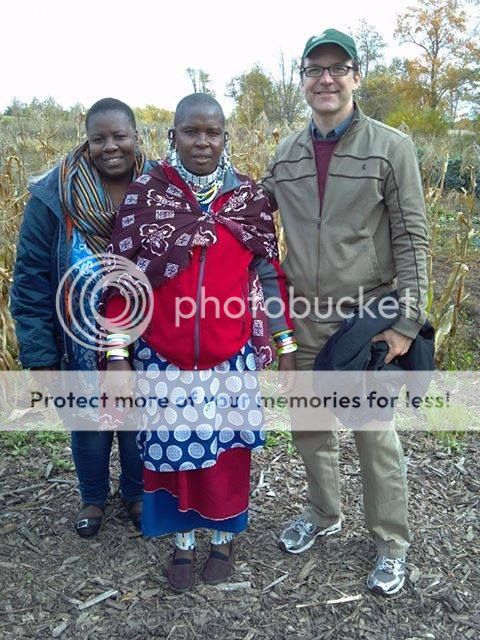
Kijoolu Kaliya featured center

On the largest stage at the conference, Kijoolu Kaliya shared her firsthand experience with land grabs to a packed room and some of the biggest applause received by any World Food Prize speaker. Ms. Kaliya is a member of the Masaai community in Tanzania and a prominent community leader as well as a pastoralist. Over the past four years, she has been forced to fight two land grabs threatening the livelihoods of her people. The most recent of which came from a rich investor from the United Arab Emirates who was attracted to the lush landscapes and thriving wildlife where Ms. Kaliya lives which the Masaai culture has been working to preserve and nurture for years. After the government of Tanzania approved the land deal with this investor , he decided that he would drive Ms. Kaliya and her community off of their land by force. The Masaai people had their homes burned to the ground and were physically assaulted by the investor's thugs. Masaai leaders are traditionally male, but after this egregious attack, Ms. Kaliya mobilized the women in her community to do what the men had failed to do, protect their way of live. She organized a five day trek to the capital of Tanzania to demand an audience with the President by returning 2,000 political party membership cards to the government. This show of force got the President's attention and resulted in him making a public declaration affirming that the Masaai people were the rightful owners of their own land and that the investor had no claim to it, but this declaration was only verbal and in this day and age a verbal agreement is little assurance, especially when it comes to the livelihood of your family. Now Ms. Kaliya is fighting for a written contract guaranteeing their land rights, because as Ms. Kaliya stated “land is life.”

Harriet Nakabaale featured center

Speaking at the Oxfam sponsored luncheon featuring Oxfam America's President Ray Offenheiser was  Harriet Nakabaale, a sustainable and organic farming advocate from Uganda's capital city Kampala. With help from her son Jjumba Frank Luyinda, Ms. Nakabaale turned her home into a small urban farm called Camp Green. Through Camp Green, the mother-son team teach local community members, schools and local governments the importance of finding creative ways to re-purpose what most people would consider waste, protect the environment, and grow sustainable and nourishing food. Together they work to alleviate poverty within and outside of Uganda by arming people with the knowledge necessary to take food security into their own hands and grow the food that they need. Ms. Nakabaale shared her story with hundreds of people and also stressed the importance of tackling domestic violence by empowering women with the necessary tools to become bread winners.

At this year's World Food Prize, on behalf of Oxfam America, Kijoolu Kaliya and Harriet Nakabaale gave voice to the underrepresented majority working towards food security on the ground - the small-scale farmers, community leaders and advocates. These two women helped bridge the gap between theoretical discussions and the harsh realities facing families and communities around the world while also shedding light on the meaningful triumphs women are helping to accomplish everyday.


Want to learn more? Check out this video from Harriet here! 
http://www.oxfamamerica.org/articles/harriet-nakabaales-camp-green/

Monday, November 4, 2013

World Food Day - and breaking the first rule of biology

Guest blogger Maria “Rose” Belding is a senior at Pella High School in Pella, Iowa. Maria is a social justice writer, advocate and one of the youngest selected candidates in the history of the Wallace-Carver Fellowship Program for scientific research. In this blog she writes about playing the ‘middleman’ in an Oxfam America Hunger Banquet, which is a special role invented by supporters in Iowa.  The middleman serves as gatekeeper to an extra helping of dinner, driving a hard bargain with participants.  This simulates the unfair terms by which many in poverty must negotiate access to needed markets, goods, and services.


I am an Oxfam America Hunger Banquet veteran. I have participated in events with 500 attendees and with 20, dinners held in formal ballrooms and in school cafeterias, and sat on the floor and stood at the podium. The dramatic contrasts between the rice on the carpet and the cheesecake on the table are no longer shocking to me, just sad; I am prepared for the opening speech, closing remarks and the radical shift in perspective that occurs in between.

This weekend, however, at what marked my tenth Hunger Banquet, I still found myself surprised.

As a returning alumni to the World Food Prize Foundation’s Global Youth Institute, I was volunteering as staff for the weekend and helped set up the Banquet. As we began to divvy up duties for the evening, I was asked to be the Middleman, essentially the only role I had not played in my multiple forays into the world of simulated wealth allocation.

I accepted the chance as a challenge: could I really be as mean as many middlemen had been to me?

Turns out, I could be and was. I was shocked by how easily I could manipulate participants into committing truly terrible acts, even though fictional ones. Asking the students and their teachers to behave as though they really were living the lives described on the colored cards that decided their fates, I was easily able to leverage what little assets or power they had. A woman who ran a shop in Afghanistan agreed to report back on the conversations of the American soldiers who stopped by her store in exchange for two meals. A recovering drug addict gave me access to his former circles and acted as a mule. Men sold me their sisters and sisters sold their sons. Actions we would all think unthinkable were considered or taken, even if it meant the loss of life.

I did as I was told I should; this was what was supposed to happen. The point was made, and the students and teachers learned.

Nobody warned me how bad I’d feel about it.

As I said earlier, the fact that hunger fuels desperation was not a new revelation for me. But being on the other side of the negotiating table showed me how easy it is to break all other rules when the first law of our biology has been transgressed - when we cannot give our bodies the fuel to function, all else is fair game if it will get us to what we need to survive. If we want to rid the world of its horrors, of genocides and human trafficking and drug trades, the best course of action will not be monitoring these atrocities and punishing the few offenders we can catch and convict. Instead, our greatest investment would be in feeding those who are not evil but may be forced to do evil things.

War is not always about weapons, and hunger is not always about food - but if we can prevent both by better allocating our resources, perhaps we can right the wrong after all.
 
The author (left), pictured at the Hunger Banquet in Des Moines with her business partner Tariro Makoni, fellow advocate. In addition to their work on engaging youth, the pair are also co-creators of the M.E.A.N.S Database, a system that allows food shelves to better communicate regarding surplus food.